
Woodland Medicine: How Art Guided My Way to Kaandossiwin
The Destination, from Anishinaabe Aki to Tahltan Keyeh
Today I want to discuss the second edition of Kathleen Absolon’s (Minogiizhigokwe) Kaandossiwin: How We Come to Know. While this foundational text acts as a vital portal for the world to see through an Anishinaabe lens, it served a more personal purpose for me: it became my guide for navigating the space between Nations. As a visitor to Tahltan Keyeh, it was this book that anchored my efforts to integrate their ancestral worldviews into a transformative new framework for mineral exploration.
But to truly appreciate the depth of this work, I must share the winding path that led me to it—a journey where art, lineage, and coincidence acted as my map. To understand the Kaandossiwin—the literal “how we come to know”—I first had to remember how I was taught to see.
The Beacon in the Brush
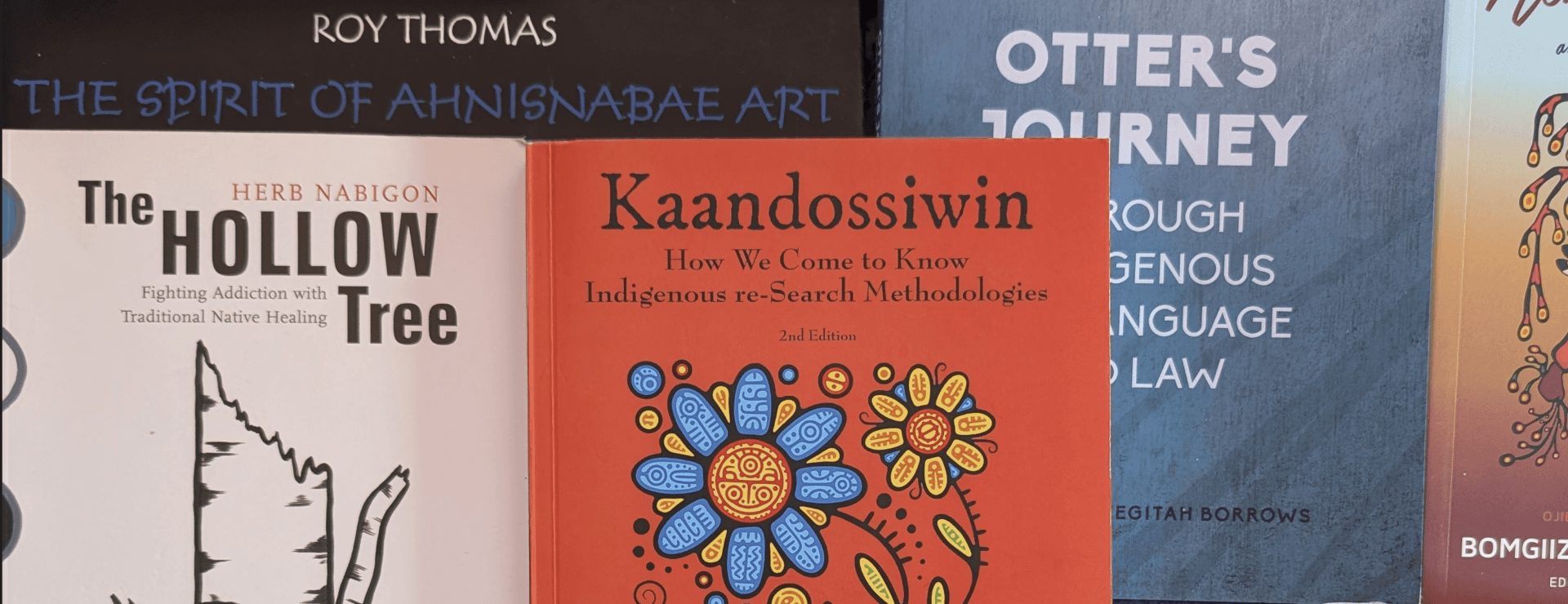
I was raised with the understanding that Woodland art is medicine. This wasn’t a metaphor; it was a lesson passed down from my mother, a member of Fort William First Nation, Animikii-wajiw. She grew up in Shebandowan and Port Arthur before eventually moving to Ottawa and then Peterborough. It was in Thunder Bay where she first built her friendships with artists and teachers like Roy Thomas and Herbie Nabigon—whose book The Hollow Tree remains a vital text on Indigenous sobriety.
Later, in Peterborough, her work was deeply inspired by the Kinomaage-Waapkong (The Teaching Rocks) and the vibrant circle of Indigenous artists she met there. Through her, I learned that the shapes, lines, and spirits on the canvas are literal language. They are a form of literacy used to encode generational knowledge and “sciences” that Western alphabets often miss.
For me, that medicine eventually became a compass. While I had always admired the style, seeing the work of local artist Tsista Kennedy (an Anishinaabe and Onyota’a:ka artist, belonging to Beausoleil First Nation and Oneida Nation of the Thames) felt like a fresh activation of those old lessons. We are both alumni of the BealARTS program at H.B. Beal Secondary; Although I attended years before he did, I made it a point to check out the new classes each year, attend the art shows, and visit local gallery displays featuring alumni work.
It was through this ongoing connection to the London art scene that I was first introduced to Tsista’s work. From that point on, his imagery seemed to follow me—appearing in digital spaces, across social media, and in the physical reality of our city, like the mural he designed at an Indigenous Wellness space in a hospital in London. The bold lines and spirit connections in his work demanded my attention at a pivotal moment. It was his art that first prompted me to join the Indigenous Friends Association (IFA) mentorship program, and later, it was his cover art that led me to finally pick up Kaandossiwin.
The Search for Deeper Resonance
Before this journey began, I had spent over 15 years as a creative in London, Ontario—at the fork of the Thames, or Deshkan Ziibiing. My days were filled with design and photography, specifically helping musicians flowing through Fanshawe and Western University discover their brand and share their identity. While that city gave me so much—from my BealARTS education to the chance encounters with Tsista Kennedy’s work—I felt a pull toward something deeper. I realized that while I was helping others find their voice, I was still searching for the full resonance of my own.
Taking a step back from my previous career allowed me to find the IFA, which introduced me to the Global Indigenous Development Trust (GIDT). What started as an internship placement through the IFA became the catalyst for a total career pivot. Over time, I transitioned from an intern to the Director of Strategy and Storytelling. My 15 years of branding wasn’t lost; it was repurposed to help Indigenous Nations communicate their sovereignty and values in spaces that have historically ignored them.
Defining the Path: What is Kaandossiwin?
In Anishinaabemowin, Kaandossiwin translates to “how we come to know.” It isn’t just a word for knowledge; it describes the process of seeking it. It implies that knowing is a continuous journey and a relationship—one that involves the spirit, the heart, and the land, not just the mind.
Re-Searching the Framework
In my work on the Critical Relationships project, I faced a massive challenge: how do you take a system that is inherently colonial and extractive and make it speak the truth of the land? By this stage, I had transitioned into the lead for Creative Strategy and Communications for the project. The responsibility for how we messaged this framework and how we strategically integrated Indigenous values sat with me.
Kaandossiwin became my guidebook in this leadership role. Understanding “how we come to know” allowed me to stop trying to “fit” Tahltan values into a Western report. Instead, I began to see the report through the lens of the Tahltan language. By centering these concepts, the Indigenous values began to outshine the colonial structure. We weren’t just translating words; we were asserting a worldview where stewardship and reciprocity are the primary “data points.”
The Power of ‘Ojibweish’: Language as a Precision Tool
During her doctoral research, Minogiizhigokwe (Absolon) found that some of the most profound writing from Indigenous academics didn’t come from standard academic papers. Because those formats are inherently Western, they often force “traditional” knowledge into a secondary, “alternative” position. To remedy this, she and her colleagues began utilizing what they referred to as Ojibweish.
The practice involves including Anishinaabemowin words directly in the English text, using footnotes to explain them. The reasoning is brilliant: to translate these words into English every time results in an inherent loss of meaning. English often requires many more words to explain a single concept that Anishinaabemowin handles with ease. The Anishinaabemowin language excels at concisely compounding concepts together through prefixes, suffixes, and root words. By getting the reader comfortable with these words, we prime them for the holistic worldview required to actually hold a “bird’s eye view” of such a complex web of relations.
The Science of Story and Symbol
We often hear our stories and art dismissed as “folklore,” but these are actually our ancient sciences. For thousands of years, Indigenous people have used art and storytelling as high-level mnemonic systems.
A spirit line in a drawing isn’t just an aesthetic choice—it’s a data visualization of an ecological relationship. A word in Anishinaabemowin isn’t just a label—it’s a compressed file containing centuries of environmental observation. These systems help us understand complex webs of relations that a standard geological survey could never capture. They anchor our work in a reality that is older and more resilient than any government framework.
Looking Ahead: The Upstream Journey
All of this work—the art, the mentorship, and the methodology of Kaandossiwin—points toward a single concept: Kinwezhiwewin. This is our “guided way” of decision-making and law, a reminder that the path is already written into the land if we have the eyes to see it.
For years, Deshkan Ziibiing was my nest, a place of learning and creative labour. But the current is calling me to investigate what lies further upstream.
In my next post, we will explore Kinwezhiwewin through the lens of Lindsay Keegitah Borrows’ (Chippewas of Nawash First Nation) Otter’s Journey. I’ll be sharing how her work guided me as I developed a workshop on place-name rematriation, and why language revitalization is the ultimate compass for building community and honoring natural law.
If you would like to see more of Tsista Kennedy’s artwork you can follow him on Instagram and Facebook as Hotdog Water Art or check out his website at https://hotdogwaterart.com/